Showing posts with label Hayley Leach. Show all posts

Thursday, December 3, 2015

Ups and Downs (Research Reflective Essay)

Image Source
This semester was a wild ride. I started off my college journey by taking an English composition class. There were ups and downs; things I struggled with and things I excelled in. I learned from others and I learned more about myself. By taking this class, I grew as a student and writer.

It got me to think about my college goals. At the beginning of the semester, some of my goals were simply to get good grades and finish assignments on time. I achieved my goal by generally getting A's on my papers and handing them in when they were due. Another goal was to manage my time well. Although I allowed myself enough time to work on most of my assignments, when I was assigned my research essay, I found that I hadn't given myself enough time to write it at a relaxing pace. Next semester, I would like to plan ahead much better and begin working on my biggest paper in advance, long before the paper is actually due. That way, I won't be cramming so much work in a small period of time, which would reduce my stress and help me be the best writer I can be.

This class helped me to learn how to research, while also helping me discover what I like and don’t like about the process. How I researched my topic was by simply searching for articles about restaurants and portion sizes through Google and online databases. While I did some research before I began writing my essay, I continued researching as I wrote because I realized I needed more information to support my argument as I went along. Some of my points were about obesity and food waste, which needed specific statistics to back them up properly. There were many different articles about my topic, which I enjoyed reading. It was nice to read others’ opinions that were similar to my own, but also interesting to learn about others’ thoughts on the subject I had never considered. I disliked finding out that some sources included statistics that were too old to include. To best support my argument, I had to search a bit longer for newer study results and statistics. Sometimes it was difficult to find the exact information I needed, but it was fairly easy to figure out how to cite the sources when I found ones I could use. Although I have no idea of the exact amount of time spent researching, it may have been better to spend even more. If I had started working on my paper in advance, it would have allowed me to enjoy the research process more.

The research essay assigned in this class encouraged me to find new and surprising source information. While researching, I was surprised to find so much information about restaurants and their menus. I thought there would be enough information on my topic, but I had no idea there would be as much as I found. It was also surprising to find that authors of several articles online often quoted or paraphrased the same works, which I found interesting. When researching, I learned about many statistics and study results about my topic I never knew before. Naturally, I also learned about others' ideas, thoughts, and insights about the topic. It was interesting to find that source information could come from a cookbook. In the cookbook, More-with-Less, the author sprinkled her own thoughts, opinions, and information she gathered about nutrition, eating habits, and how to avoid wasting food. I wanted to include a print source in my paper, but didn't have enough time to run to the library for a book. So, my mom suggested that cookbook, which we happened to have at home with our other cookbooks. I was skeptical that I would find anything that would add to my paper, but as I skimmed through it, I found many interesting things she wrote. One quote stood out to me, and I included it in my paper. It helped me to create a whole separate point which I think improved my essay.

It helped me to write a research paper I am proud of. One of my favorite parts of my essay is my introduction, because I wrote about how fun eating out is before I stated my argument. I think it makes my paper seem more personal and conversational. Another aspect of my writing I like is how I addressed both sides of the situation, which makes my paper be relevant to those in the restaurant industry and the consumers. I’m glad that I was able to include source information by paraphrasing, summarizing, and quoting. As much as possible, I tried to alternate between these different ways of integrating sources. While I did use a variety of sources, I made sure to state my own thoughts and opinions in my own words as much as I could. I think I was able to mesh my words with others’ words and ideas in a balanced way.

This class helped me to think about what my professor might want me to include or exclude from my paper. My professor has mentioned that she strongly dislikes when I use the word “the” too often when it is unnecessary. Because of this, I made sure to go over my paper and take out the word "the" wherever I could. I’m not sure if she will notice the absence of this word, but I think she would like it if she does notice it. Also, I think she will like that I added variety to my Works Cited page by using digital and print sources.

This class has helped me to improve as a student. At the beginning of the semester, I did not know what MLA format was, and now I know how to use MLA on my computer at home and on the computer at school. As far as internet skills, I also feel like I have learned how to find valuable information and tell the difference between reliable, accurate sites and mediocre sites. While researching, it was very helpful to organize quotes and information I was thinking about using in documents on my computer, and making sure to include necessary information for in-text citations after or before each quote or bit of information. With this system, I was able to organize source information into different categories, while knowing all the necessary information for each quote. I would definitely recommend this system to other students.

While I have learned quite a bit this semester about my strengths, I have also learned about what I can improve. I would like to make sure to outline my next research paper in as much detail as possible earlier on in the semester because it would help to focus my research and save time. By taking this class, I learned about what I excelled in and what I needed to work on. I also learned about how to research, which helped me to create a research essay I feel good about. Overall, this class helped me to improve my writing skills and become a better student. The semester was a wild ride, but it was well worth it.

Written by Hayley Leach

Thursday, November 12, 2015

Improvement of Drafts

Image Source

How I Improved My Rough Draft:
  1. I thought my paper was very cluttered, so I put all of what I have of my paper so far, and put it into broad categories, in hopes of being able to get my paper to a more organized state. Over the weekend, I will form it into working paragraphs and include source information.
  2. I expanded my intro by including my own thoughts about how eating out at restaurants is good thing that people enjoy. I think this will help to soften my paper and show readers why they should care about my argument.
  3. I changed the title of my paper from Restaurants Should Offer Smaller Meal Portions to Less Is More. I think this is a positive change because it makes my paper seem more lighthearted and meaningful. The first title seemed more like a thesis slapped at the beginning of the paper, all by itself, but my new title seems more catchy and relatable.

How Kelsey Improved Her Rough Draft:
  1. I asked Kelsey to add the age of her friend that she interviewed, and she did. By adding this, it gives the reader a better understanding of where her friend is coming from.
  2. She changed some sentences in her paper that did not make sense to me. Now, because these sentences were changed, they now make sense.
  3. On her third page, she mentioned a statistic about women not being able to find men to marry. In her first draft, she did not give documentation, but she added this documentation in her second draft. Now, the reader can know who she got that information from.
Written by Hayley Leach

Wednesday, November 11, 2015

Chapter 17: Integrating Sources and Avoiding Plagiarism

Image Source
Personal Reaction:
Chapter 17 from Patterns for College Writing by Laurie G. Kirszner and Stephen R. Mandell mainly explains how to integrate sources and avoid plagiarism. I really should have read this chapter earlier, because I was having a tough time figuring out how to start the process of integrating other people's information in my research paper. Because of this confusion (and having a cold), I wasn't able to write my paper as quickly or effectively as I would have liked to. The writing process would definitely have been much smoother if I had already read this chapter. But, now that I have, I will be able to use what I learned to make my research paper better.

This chapter is filled with helpful tips. One that really stuck out to me was making sure to take plenty of time to research and write your paper. For whatever reason, I did not do this. Thankfully, unlike the meme above, I didn't have to write a thirty page paper, and I did not put off writing it until the day before. But I was assigned a 5-7 page paper, and I only gave myself about 4 days to write my first rough draft, which was not enough. Clearly, I should have started working on this several weeks in advance. Now, I have to cram, which is stressful and not fun. In fact, I probably should be working on my paper right now, but I'm writing this instead. Oh, well. You live and you learn.

Professional Reaction:
Although this chapter is fairly short, it is packed with valuable information that I will definitely refer to whenever I am assigned a research paper.

In the first part of the chapter, the authors mention different ways of integrating sources into a paper, which are paraphrasing, summarizing, and quoting. They define and describe each of these briefly, and also include examples and guidelines for how to use these techniques. The rest of the chapter explains what plagiarism is and how to avoid it. I think all these tips, guidelines, and examples will help me integrate sources in my paper correctly, and help me to not plagiarize.

Written by Hayley Leach

Thursday, November 5, 2015

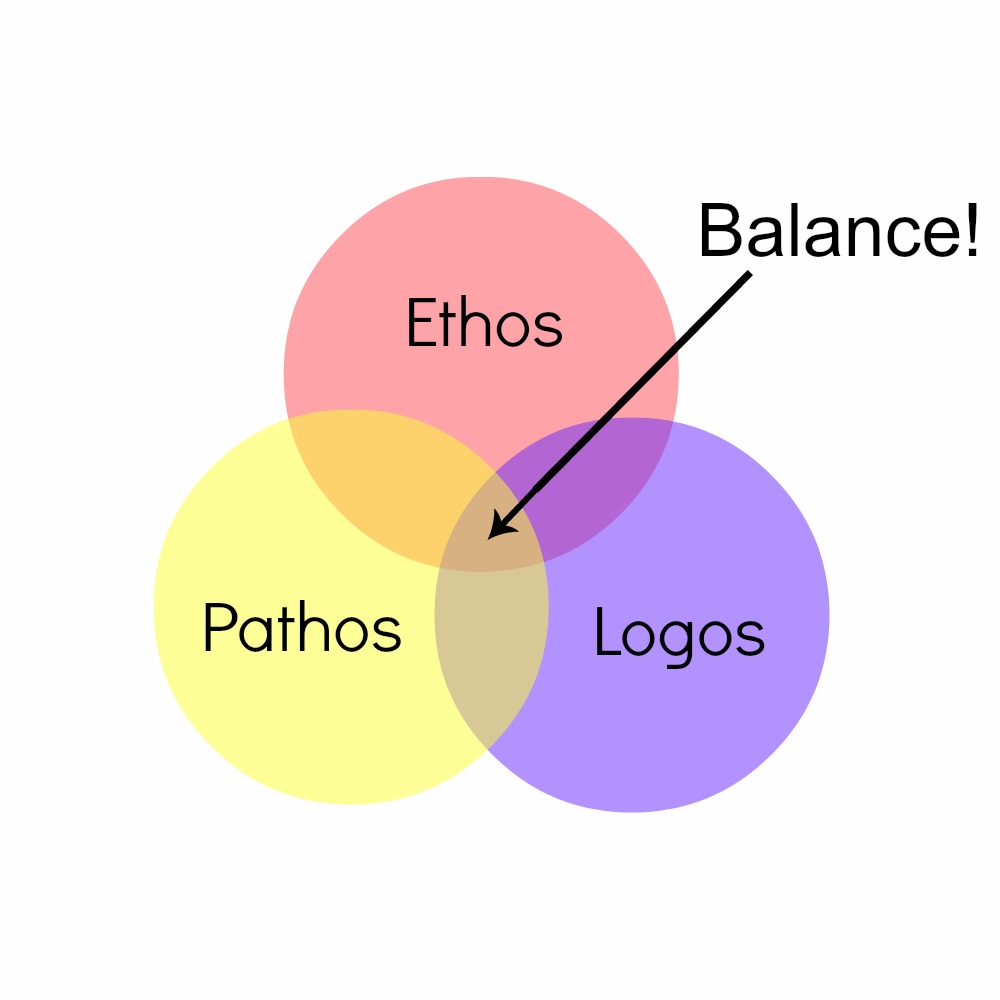
Ethos, Pathos, and Logos Outline

Image Source

Below is my list of possible support points for my research essay, which appeal to Ethos, Pathos, and Logos.


Ethos is when you convince the reader of your credibility or expertise on the subject, either by using your own knowledge or using sources from others. 

Because I am not an expert on my topic, I will use sources from others with high credibility and expertise.


  1. I will use Ethos when I quote or paraphrase the article, "Mitigating the Health Risks of Dining out," from the American Journal of Public Health.
  2. I will use Ethos when I quote or paraphrase the article, "Standardizing Portion Sizes May Not Benefit Human or Environmental Health," from the American Journal of Public Health.
  3. I will use Ethos when I quote or paraphrase the article, "The Contribution of Expanding Portion Sizes to the U.S. Obesity Epidemic," from the American Journal of Public Health.
Pathos is when you use emotion to convey your points of debate or argument in a way that might be relatable to the reader.

  1. I will use Pathos if I include interviews and/or stories of dining out from friends and family.
  2. I will use Pathos if I give personal examples of the negative impact of restaurant meal portions in my own life. 
  3. I will use Pathos when I quote a web article, "Living the Chipotlife: 23-year-old Man Eats Chipotle for 153 Days Straight," from USA Today.
Logos is to appeal to reason; to use logic to present your case.
  1. I will use Logos when I mention that decreasing portion sizes would logically reduce obesity.
  2. I will use Logos when I explain that, if portion sizes are decreased and obesity is minimized, diseases and medical conditions will then also be reduced.
  3. I will use Logos when I address how money and time will logically be saved.
Written by Hayley Leach

Monday, November 2, 2015

Chapter 16: Finding and Evaluating Sources

Image Source
It's Monday already and I'm finally getting around to posting my reading response to chapter 16 in the textbook, Patterns for College Writing.

When I quickly looked over this chapter last Thursday, my first thought was, "Wait, that's it?!" The chapter is literally only 6 pages long. It's probably the shortest chapter in the book.

Although the chapter is short, I found myself taking the whole weekend to read it because I was so busy getting ready for Halloween. After all the Halloween festivities, I started to get sick. I'm still a bit under the weather, but getting over it.

Anyway, back to the response. I did finally finish reading the chapter, which took practically no time at all. The first part of the chapter talks about places to find information, such as libraries, databases, and the internet. At this point in my education, I'd say it's no challenge for me to know where or how to get information. Information is available everywhere these days. All the same, I think this part of the chapter could be beneficial to someone who is not sure how to find sources for his or her research paper.

Things really got interesting in the second half of this chapter, which talks about questions to ask yourself to evaluate sources when you're doing research. Professionally, I think these questions will be helpful for me to ask myself when researching. The questions are used to evaluate the quality of sources. I think it will really help me if I make sure to think about if the information I find is authoritative, accurate, objective, current, and comprehensive. In other words, I need to find out if the author of the source is an expert or not, and if the information is factual, not altered by biases, up-to-date, and covers the subject in sufficient depth.

Basically, this chapter is short, but sweet. Sort of. When I say, "sweet", I mean thought-provoking. It got me thinking about how, because there is so much information out there, I need to take time to evaluate the quality of information I find, in order to use the best quality sources for my papers.

Written by Hayley Leach

Monday, October 19, 2015

Video Project

We made a grammar lesson video on nouns, verbs, and adjectives. We hope you enjoy it!

Monday, October 12, 2015

Evaluation of Internet Resources

Image Source

In order to practice evaluating the quality of internet resources, I chose a topic and began researching online. 


Although I have been tossing around a few topic ideas in my mind for my next argumentative essay, the topic I chose for this exercise is child beauty pageants. Specifically, the negative effects of beauty pageants on children and why they should not be entered in such pageants. First, through Google Search, I found a collection of articles on this topic on huffingtonpost.com.


Website Impression:
The first thing I noticed was the variety of information that is available on the site; news, entertainment, media, politics, business, healthy living, and even comedy. I also noticed that, although The Huffington Post is a well-known news publication and provides quite an impressive array of information, it seems a bit lacking. I'll explain. I was looking around the site for some sort of "About Us" page, and found a link to such a page at the very bottom. When I clicked the link, it took me to a page with all of the names of everyone involved in making the website run, but there was nothing written about how, when, or why The Huffington Post was created, which disappointed me. Personally, I think it would help me care more about the website if I was able to learn a bit more about the history of it via the website itself. That said, the information on the site seems to be credible and relevant, and is presented well with images and catchy titles.

Unfortunately, most of the articles on the website are very short, but I did find one post that went more in-depth on the topic of child beauty pageants. One thing the author, Deborah Cruz, wrote really stood out to me, "I am trying to raise my girls to value themselves for who they are on the inside. I want them to value others for who they are on the inside. I don't want superficial, shallow children." (Cruz)

Evaluation of Website based on General Criteria Guidelines:

  • The organization name, The Huffington Post, is clearly visible at the top of the website, and most articles on the website have the authors' names shown under the titles. Since there is so much information and news stories on the site, I would say there are a combination of experts and non-experts who write articles that are featured on the site. The information on the site is appropriate for the commercial nature of the organization.
  • The purpose of the site is to inform the reader of newsworthy information, for educational purposes and for entertainment. It is not a biased website because it includes articles with differing opinions on the same topic.
  • The site does have the presence of ads. There were advertisements for Yellow Tail wine and Audible.com, which implies that the site is mainly targeted towards adults and generally not suitable for children.
  • The articles I read included some in-text citations, but there was no other citations to be seen anywhere. These citations do give me a good idea of the sources of the information used, but are not fully cited. Many of the articles are simply informing the reader and not necessarily making an argument. Some articles are about someone's opinion, and are backed up mostly with personal experiences. The site does not seem to be backed up by academic research.
  • The website is updated almost constantly, due to the constant stream of newsworthy information to be shared every moment. The links seem to be relevant and appropriate for each topic. Most of the articles are rather short and only cover each topic on a superficial level. Some of the content is appropriate for printed publication, while some content is probably meant only to be posted on the site.
Database Article Evaluation:
The article I chose to evaluate from the database is, Childhood Beauty Pageant Contestants: Associations with Adult Disordered Eating and Mental Health. The authors seem to really know a lot about the topic. They are very logical and include a lot of statistics and references, which are cited properly. Although the article is a bit impersonal, it is well-written. It includes information from several sources, one of them being the Journal of Personality and Social Psychology. With all the medical and psychological statistics and studies included in this article, it seems properly backed up with accurate information.

Comparison of Website and Database Article:
Personally, I enjoy being able to gain information through a more personal, conversational read, which is what the Huffington Post website gives. On the other hand, the database article gives more fact based information drawn from studies, which did not seem to be included in the articles on the website. I think both are beneficial to read in their own way and are written well.

Works Cited:

    Cruz, Deborah. "The French Government Bans Child Beauty Pageants and I Hope it Catches On." huffingtonpost.com. 12 October 2015. Web. 12 October 2015.
Wonderlich, Anna. Ackard, Diann. Henderson, Judith. "Childhood Beauty Pageant Contestants: Associations With Adult Disordered Eating And Mental Health." Eating Disorders 13.3 (2005): 291-301. Psychology and Behavioral Sciences Collection. Web. 12 Oct. 2015.


Tuesday, October 6, 2015

Blog Review #2 - Five Brains Are Better Than One

Image Source
As I was looking at the group blogs from my class, the blog that stood out to me the most was Five Brains Are Better Than One. What really caught my attention was how visually interesting it was. For one, the title is very catchy and gives the impression that the five writers have a sense of teamwork and enjoy working together to create the blog. Another thing I really enjoyed about the blog was how engaging their posts were because they included funny or unexpected images in each post. Their images often made me laugh or smile.

Although the blog is generally visually appealing, I would suggest that they change their background from such a bold red color to something a little more relaxing. It would make me want to spend more time reading the blog if the background was a lighter color.

That said, Five Brains is very well-written and engaging. I enjoy reading it because of how much detail and personality each post has. It's written in a very personal and lighthearted way, which is something I need to work on in my own writing. In fact, I think I have already drawn some inspiration from their blog when I sat down to write this review. Sometimes it can be hard to make each post conversational and relatable on this blog when all I post are assignments, but Five Brains reminded me that it is possible to make assigned posts interesting.

Overall, I think these five classmates were successful in creating and maintaining an interesting and engaging blog with a lot of personality and character. Each post was similar in length and style, which made the blog look organized and consistent. I was impressed with the variety of thought-provoking topics for their essays and their thoughts of their assigned reading from the textbook. If someone outside of our English composition class stumbled upon Five Brains, they would get a pretty good idea about what each chapter in the textbook is about and what the most important points from the chapters are. Personally, I found writing inspiration from this blog, and I plan on continuing to read it throughout the semester.

Written by Hayley Leach

Monday, October 5, 2015

Chapter 14: Argumentation

Image Source
Personally, I had never really thought to come up with an antithesis (exact opposite of my thesis) in order to make sure my argumentative thesis is debatable. I think that learning to look at my argument from opposing viewpoints will make me a stronger writer and help me learn how to address opposition in my essays and in arguments or debates I may have with others in the future.

Professionally, this chapter is one that I see myself referring to often for future argumentative essays. Although this chapter is full of important information, I think the most helpful things I learned are that argumentation essays must make points, supply evidence, establish logical chain of reasoning, refute opposing arguments, and accommodate the audience's views.

Written by Hayley Leach

Thursday, September 17, 2015

Outline For Kelsey's Thesis


Kelsey's Thesis: "My belief in God helps me to understand who I am and has taught me the importance of values that better myself and the world around me"

Example 1: Going to church helps me learn more about God. When I'm at church, I read the Bible and worship, which helps me develop and learn how to be a better person.

Example 2: Spending time alone praying helps me relax and feel peace, which makes me feel at ease and helps lower my stress, helping me to act kinder to others.

Example 3: Learning about God's values has guided me through tough times and helped me get along better with others.

Conclusion: Myself and the world around me are made better because of my belief in God.

Logical Fallacy #1


Jumping to Conclusion.


Defined: "Hasty, or sweeping generalization", the writer makes a conclusion when they do not have enough information or evidence. Jumping to conclusions causes people to judge or decide without having the facts or based on their own biases, thinking everyone would agree with them.  

Tip:  Don't think that people agree with all your opinions, and make sure to have a complete amount of information before you make a point. 

Image

Wednesday, September 16, 2015

Tuesday, September 15, 2015

Just Walk On By

Comprehension:

  1. The woman is a "victim" because she is the first person to that he noticed was scared of him and reacted because she was scared of him. 
  2. He has the "power to alter people" because of the way that he looked. People got scared when he came into view because of their own judgments of people and their racial profile at first glance. 
  3. He walks the streets at night because everybody is scared of him, he says that things can get very "taut".  He also walks the street at night because he is a night walker and he is "suffering a bout of insomnia".  
  4. "The making of a young man" - "the consumption of the male romance with the power to intimidate", "perception of themselves as tough guys", "embrace the power to frighten and intimidate", learning to "seize the fighter's edge in work and in play and even in love", "be valiant in the face of hostile forces".  Young, poor, and powerless become thugs because they take all these hints to becoming a young man seriously and end up in trouble.   
  5. He attempts to make himself less threatening by moving with care, staying further away from people that seem to be nervous especially when in jeans and not his business attire, he walks by letting people clear the lobby before he returns, he tries to be calm and congenial, and he often whistle's songs from Beethoven and Vivaldi.
Purpose and Audience:

  1. "It was in the echo of that terrified woman's footfalls that I first began to know the unwieldy inheritance I'd come into - the ability to alter public space in ugly ways."
  2. He uses logic and emotion, which is an appropriate strategy.
  3. He seems to assume that his audience is familiar with the concept that black males are often seen as intimidating, but he assumes that his audience is not necessarily aware that not all black men have malicious intent.
  4. He succeeded in drawing the reader in, which is what I think his intention for the first sentence was.

Style and Structure:

  1. I think he mentions Norman Podhoretz because he needed an example from someone who was not black, in order to get a different perspective.
  2. I think his opening strategy is very effective.
  3. Staples definitely had enough examples to support his thesis. I think that they are representative. The types of examples that Staples used in his essay were very convincing, because he mentioned in different situations how people acted pretty much the same. He also showed us how the same situations applied to him in different cities.
  4. Staples didn't have an exact order that he presented his examples. He did tell us examples that would happen in a city, then he would move on to a year or so later and tell us what happened in that city at that time.
  5. Synonyms of "thug": gangster, killer, bully, goon, criminal, hooligan, mobster, troublemaker, delinquent, and gang member. All these words have very similar meanings, implying that people labeled with these words make trouble, commit crimes, and are often violent and part of a gang.

Journal Entry:
I have been in a similar situation as Staples, but I perceived someone else as threatening. I reacted very similar to Staples first example of the women. How she took a few worried glances back and increased her steps until she started running. In my situation, I was with some friends downtown after a concert and my friend said she had noticed a white male following us for a couple blocks. We all acted like nothing was wrong, because we didn't want to show any fear, and hurriedly speed walked to our car. Even today, I would react the same, because you can never be certain of any situation. I always say better safe than sorry.

Writing Workshop:
3. Staples's statement is very accurate. I think he meant that most males strive to be big and powerful from when they are born, but it develops gradually like a romance. Growing up, I noticed many times that the boys I knew always seemed to enjoy playing with toy dinosaurs and monster trucks; things that are known as being big, scary, powerful, and dangerous. That may have been because they were raised to think that men should be bigger, stronger, and more powerful than women.

Combining The Patterns:
Cause and effect is a great way of explaining situations because then the reader can automatically see one of the possible outcomes of the problem.  Examples provide more outcomes possibly and more explanations oftentimes.  We do believe that more examples would have been a better explanation for how a youth becomes a thug.

Monday, September 14, 2015

Chapter 8: Exemplification

Image Source

I learned a lot about using examples in essays when reading chapter 8 of the book, Patterns for College Writing. Personally, the thing that stuck out to me the most was the concept that examples can be used in essays, not only to support the thesis, but also to add interest. Examples and statistics do not have to be boring. In fact, they shouldn't be boring.Professionally, I think the tools presented in this chapter will be very helpful to refer back to when I write my exemplification essay for my English Composition class. Below are three points from the chapter that I think will be most helpful for me:
  1. Use examples to explain and clarify. Be specific.
  2. Explore examples before forming your final thesis. Sometimes you may need to narrow or change your thesis to match the examples you have gathered.
  3. Use a wide variety of examples to better support your thesis.
Overall, I think this chapter is a great guide for using examples in essays. By reading it, I'm sure I will feel much more prepared and confident to write my exemplification essay.

Written by Hayley Leach

Thursday, September 3, 2015

Hayley's Mini-Essay Outline: Technology in Education

Topic: Technology in Education

The Specifics:

  • Having better access to information through the internet
  • Being able to revise and rewrite documents on the computer
  • Having a better understanding of assignments through email and text messages

Arguable Sentences:

  • Education is enhanced with the aid of computers
  • Students can better access information through the internet
  • Students can get better grades when they are able to ask their teachers about assignments through email and text messages

My favorite one: Education is enhanced with the aid of computers.


Blog Reviews #1

Image Source

Kelsey followed: Whatever Frail My Heart Apart by John Scalzi
Rating: 8/10 Great pictures and science fiction writing. The writing is interesting. Some posts seemed too long.

Hayley followed: Mental Floss
Rating: 6/10 There are a lot of great pictures. The writing is interesting. There is a variety of topics that they write about. But they are lacking detail in their writing.

Sofia followed: Underground New York Public Library
Rating: 6/10 It was visually appealing with a catchy title. Not enough blog description.

We (Creative Minds) decided that our favorite blog is "Whatever". We generally like this blog because we thought that it was visually appealing, well written, and there's a wide variety of topics. This pictures posted on this blog made the posts more interesting and realistic. As we followed this blog, we noticed the cover photo changed every so often, bringing a new thought to our minds.

John Scalzi is a science fiction writer. We believe because of this that his posts were really easy to follow and kept us entertained. He didn't make many mistakes with his grammar, so it was easier to read. Although he had great writing, we found that some posts were too long and often lost our attention by the end.

Recently, there was a Hugo award and he wrote about that and books for a few days. His latest post was about a post he wrote ten years ago titled, "Being Poor". He also posts about his cat often, which makes the blog more entertaining and shows his personality. Overall, we enjoyed following the blog, "Whatever" because of its appealing nature.

Tuesday, September 1, 2015

Reverse Outline: Email Etiquette

Image Source

1. Introduction: Describes himself and how he communicates through emails, compared how more powerful people communicate through emails.

2. Thesis: "See, the e-blurt, like so many modes of personal expression, is all about power."

3. Support: Powerful people spell poorly on purpose showing that they are busier, hence they are more powerful.
 
    Support: High power doesn't necessarily mean good or high level grammar. "Hip power" meaning not as formal.

    Support: "What are you trying to say?" Making the people under you try to guess what you're trying to say. They think that they are to important to correct themselves.

4. Counter argument: He talked to his lawyer friend and she said that "If your poorly written email messages are retained as one of the companies electronic business records, and the company is hit with a lawsuit, and your email is subpoenaed, the fact that your messages were written in an unprofessional, illogical way could come back to haunt not only you but the company as well."

5. Conclusion (not very long): Basically just restates the thesis.

6. Thesis #2: "Which only confirms what I always felt about power; That the people that really understand it don't say anything at all."

Monday, August 31, 2015

The Importance of Arrangement


Arrangement is important.

Occasionally, I post to my personal and movie review blogs. When I write new posts, I am often aware of the importance of an introduction, body, and conclusion, but not necessarily aware of the importance of arrangement. It is certainly important to arrange all the sentences and paragraphs in your writing to blend and work well together, while also conveying your main points to the reader.

While reading about arrangement in chapter 3 of the book, "Patterns For College Writing: A Rhetorical Reader and Guide" written by Laurie G. Kirszner and Stephen R. Mandell, I learned some new tools and important tips on how to arrange any piece of writing, whether it be an essay or a blog post.

As a college student, I think these three points from chapter 3 are the most important and helpful in arranging, developing, and outlining your writing:

  1. The Introduction must: introduce subject, create interest, and state thesis.
  2. The Body Paragraphs must be: unified, coherent, and well developed.
  3. The Conclusion must: reinforce thesis, restate main idea, and review key points.

There are many more details and sub-points in this chapter that are also helpful. If you would like to know more, I would suggest reading "Patterns for College Writing." 

Personally, I think this chapter has really helped me to better recognize and appreciate the importance of arrangement.

Image by: Hayley Leach     

Thursday, August 27, 2015

An Interview with Kelsey Robison - by Hayley Leach

Kelsey is a very interesting person and student, and she has a variety of interests.

Kelsey likes to write.
She keeps in touch with a pen pal. When I asked her if she writes weekly emails to a friend, she said, “Not weekly, but I have a friend in Honduras, and sometimes I write emails to her.”
She mentioned that she also likes to write in her journal sometimes.
When I asked if she often writes to-do lists, she said with a smile, “I do. I have a planner and everything. I like to organize.”

She not only liked to talk about writing, she also loved to talk about books.

Kelsey enjoys reading.
When I asked what kind of books she reads, she said excitedly, “I like mysteries and love stories. Those are my favorite and I read them all the time.”

She is a creative person, but she is also a very active person.

Kelsey loves to play volleyball.
When I asked how long she has been playing, she said, “Since I was about 5 or 6. I’ve been playing a long time. I had been playing with 8 girls for 6 years and they were my best friends. They were all seniors last year, and graduated, so I was the only one left on the team.”

During the interview, we discussed what our goals are for the English 121 class. Both of us agreed that we wanted to improve our writing and get good grades, but she also mentioned that she wanted to expand her vocabulary. She also asked me what problems I anticipated for this class. I answered, “I have some issues with time-management. So, I worry about not being able to get my homework done on time.” She quickly replied, “Yeah, I’m nervous about that, too. I play volleyball at my school, and that goes from the end of school to about 6:00 or 8:00, depending on the day. So, I don’t have very much time to do things. My schedule is pretty full.”

Near the end of the interview, we were also given a chance to ask our own questions. She asked me about my hobbies, and I told her I enjoy swing dancing and scrapbooking. Then, I took the opportunity to ask her why she loved volleyball. She answered, “I love volleyball because it is a challenge for me and I never know what the outcome will be.”

It was very interesting to learn about Kelsey. Naturally, it was fun to talk about the things we have in common, but it was also fun to hear about her variety of interesting and unique set of interests.

Let Steroids into the Hall of Fame

1. What is the writer's general subject?
    The writer's general subject for this article is baseball players using drugs.

2. What is the writer's main point?
    The writer's main point is to explain his view on drug use in national baseball leagues. He believes that they should make their own choices when it comes to drugs.

3. What are the writer's key supporting points?
    One key point is that if any person uses these drugs, then the baseball players should be allowed to as well. Another one of his key points is that fans and others should be aware of and have access to the same drugs, in order to make the field level.

4. Does the writer seem to have a particular purpose in mind?
    The writer is arguing on behalf of baseball players in these leagues. He believes if the baseball players want to make that decision, they are adults and can decide on their own.  He believes that it should be an option for them to choose as long as they notify people.

5. What kind of audience is the writer addressing?
    The type of audience the writer is addressing to is fans of these leagues, athletes of these leagues, and athletes in training. Also the writer could be addressing to the board members that create these rules in order to persuade their decision and opinion about drugs.

6. What are the writer's assumptions about audience? About subject?
   He seems to be assuming that his readers need to be persuaded to agree with his opinions.

7. Are the writer's ideas consistent with your own?
   No, not currently.  Personally I believe that you would rather see how truly talented every player is rather than seeing how much drugs they can take to improve their performance. 

8. Does the writer reveal any biases?
   Yes. Although he does mention different opinions, he often follows one opinion with another that stands against the first.

9. Do you have any knowledge that challenges the writer's ideas?
   Drugs can alter performance to be better or worse.  I have seen it work in the beginning of the game, but towards the end of the game the player got very tired and passed out ultimately loosing the game.   

10. Is any information missing?
     No, not according to our knowledge.

11. Are any sequential or logical links missing?
    No, not that we know of.

12. Can you identify themes or ideas that also appear in other works you have read?
     Other themes that have also appeared in other works that we have read are newspaper articles, magazine articles and articles we have fallen upon on the internet.

13. Can you identify parallels with your own experience?
      In my experience I have been in a basketball league where another player was suspended for the use of drugs just like how baseball players were suspended for their use of drugs. Personally I think if you are prescribed to the drugs you are taking, there shouldn't be any consequences.

By: Kelsey Robison, Sofia Montalbetti, and Hayley Leach